eNACH vs UPI AutoPay: A Head-to-Head Comparison
Compare limits, setup time, costs and use cases to pick the right recurring payment method for your business.
·
10 min read
·
RocketPay Editorial
TL;DR
eNACH and UPI AutoPay both let a business debit a customer's bank account on schedule after one authorisation, but they suit different debit sizes. UPI AutoPay goes live as soon as the customer approves it and runs without extra authentication up to ₹15,000 per debit, while eNACH takes up to three days to register and handles much larger debits. Route each customer by the size of each instalment, not the size of the loan or contract, and run both if your instalments fall on either side of ₹15,000.
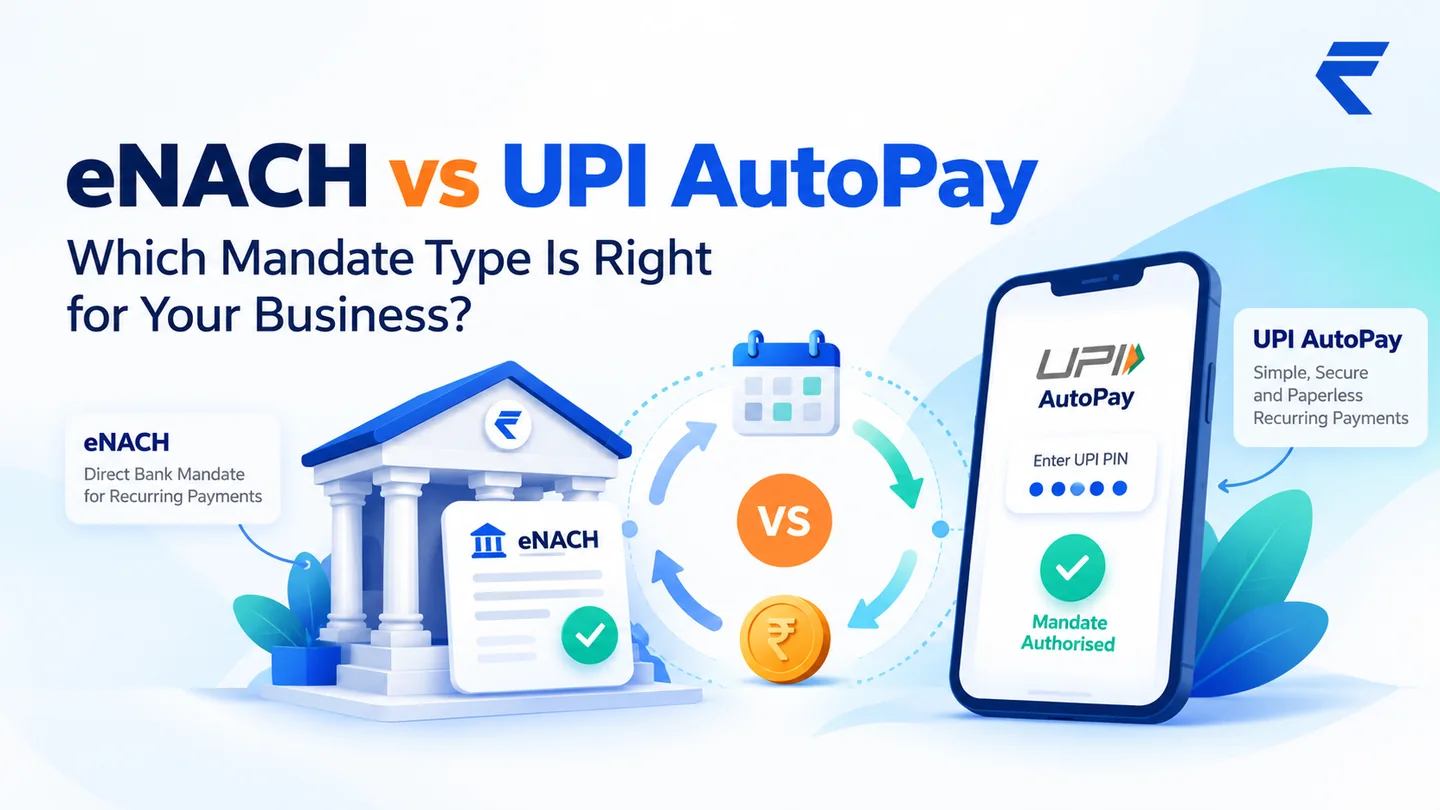
Collecting recurring payments in India usually comes down to two mandate rails: eNACH and UPI AutoPay. Both let a customer authorise once and be debited automatically after that. They differ a lot in limits, setup time, cost and customer control.
In short, UPI AutoPay suits low-ticket, high-frequency billing. eNACH suits high-value, long-tenure collections. This guide compares eNACH and UPI AutoPay on the factors that decide the choice, and shows when to run both.
Why This Choice Matters for Recurring Payment Businesses
The mandate rail you default to shapes four things in your business: how many customers finish sign-up, how many debits succeed each cycle, how much you spend collecting, and how much control customers feel they have.
A rail that suits your ticket size and customer base keeps involuntary churn low and cash flow predictable. A poor fit shows up as abandoned mandates, failed debits and support tickets. For a subscription business or a lender collecting loan EMIs on mandates, even a few percentage points of failed collections add up every month.
What is eNACH?
eNACH is the digital version of the National Automated Clearing House mandate. It is a standing instruction linked to the customer's bank account that lets a business debit it on agreed dates. It runs on NPCI's NACH infrastructure.
The customer authorises it through netbanking, a debit card or Aadhaar OTP. It does not activate instantly: registration can take up to three days, so the first debit should be scheduled at least three days after the mandate is created.
In exchange for the slower start, eNACH supports much higher mandate ceilings than UPI AutoPay. That is why it suits EMIs above ₹15,000, large insurance premiums and institutional collections.
What is UPI AutoPay?
UPI AutoPay lets a customer set up a recurring mandate inside any UPI app. They approve it once with their UPI PIN, and the mandate is live in real time. It supports both fixed and variable amounts, up to the cap set at creation.
The standard limit is ₹15,000 per debit without extra authentication. In December 2023, RBI raised that limit to ₹1 lakh for mutual fund subscriptions, insurance premiums and credit card bills, and its Digital Payments E-mandate Framework, 2026 keeps both limits.
Customers can pause or revoke the mandate from their UPI app, unless it is a non-cancellable loan-repayment mandate set up by a regulated lender. This is a big reason for its popularity among consumers.
eNACH vs UPI AutoPay: The Head-to-Head Comparison Table
Parameter | eNACH | UPI AutoPay |
|---|---|---|
Authentication | Netbanking, debit card or Aadhaar OTP | UPI PIN in any UPI app |
Mandate activation | Up to 3 days | Real time |
Per-debit limit | Up to ₹1 crore; actual cap varies by bank and mandate type | ₹15,000 standard; up to ₹1 lakh for select categories |
Sign-up steps | Bank login, card or Aadhaar authentication; more points where customers drop off | One approval with UPI PIN in the customer's UPI app |
Failure behaviour | A failed debit usually triggers a bounce charge from the customer's bank | Usually no bank charge for the customer; failures can also come from UPI or bank downtime |
Customer control | Cancellation usually goes through the bank or business | Pause or revoke from the UPI app, except non-cancellable loan mandates used by regulated lenders |
Cost to business | Provider fees vary; a failed debit usually costs the customer a bounce charge from their bank | Provider fees vary; usually no bounce charge for the customer |
Variable amounts | Supported, within the mandate cap | Supported, within the mandate cap |
Best for | EMIs above ₹15,000, large premiums, B2B, long tenures | Subscriptions, SIPs, utilities, EMIs up to ₹15,000 |
Main drawback | Slow activation, higher sign-up drop-off | Limits and dependence on UPI uptime |
UPI AutoPay is faster to set up and takes fewer steps to approve; eNACH carries far larger debits. In most cases, the size of each debit decides it.
Transaction Limits: Where UPI AutoPay Wins, Where eNACH Wins
Where UPI AutoPay wins: It covers a wide range of everyday recurring payments. Anything up to ₹15,000 runs with no extra authentication at debit time. For mutual fund SIPs, insurance premiums and credit card bills, the ceiling rises to ₹1 lakh. That covers most consumer subscriptions, OTT plans, utility bills and typical SIPs.
Where eNACH wins: Above these limits, eNACH takes over. Loan EMIs for large tickets, high-value insurance premiums and institutional collections all need higher mandate ceilings. NPCI's limits allow eNACH debits of up to ₹1 crore, though the cap available to you depends on the authentication mode and your sponsor bank. Confirm the limit with your provider before you build a pricing tier around it.
A rule of thumb by debit size:
Debit size | Recommended starting point |
|---|---|
Up to ₹15,000 | UPI AutoPay |
₹15,000 to ₹1 lakh, SIPs, insurance premiums, credit card bills | UPI AutoPay or eNACH |
₹15,000 to ₹1 lakh, everything else including loan EMIs | eNACH |
Above ₹1 lakh | eNACH |
Collecting instalments on both sides of ₹15,000?
RocketPay runs UPI AutoPay and eNACH mandates on one platform, so each customer sits on the rail that fits their debit size.
Customer Experience: Setup Friction and Cancellation Flow
Setup: UPI AutoPay asks the customer for one thing, their UPI PIN, inside an app they already use, and the mandate is live as soon as they approve. eNACH asks them to authenticate with their bank through net banking, a debit card or Aadhaar OTP, and every extra screen is a point where some customers give up.
Cancellation: With UPI AutoPay, customers can pause or revoke a mandate from their own UPI app. The exception is lending: regulated lenders can use non-cancellable UPI AutoPay mandates for loan repayments, which the borrower cannot revoke from the app.
Notifications: For UPI AutoPay, RBI’s Digital Payments E-mandate Framework, 2026 requires the customer’s bank to send a pre-debit notification at least 24 hours before each debit, with an option to opt out of that debit. eNACH sits outside that framework, so pre-debit alerts there depend on the business and its provider. On either rail, a clear reminder before every charge cuts down on disputes and failed-debit complaints.
Cost Structure: What Each Method Actually Costs a Business
Provider pricing for both rails varies, so compare each per-debit fee as a share of your typical debit. A flat fee that is trivial on a large EMI can be a meaningful slice of a small instalment. Failures also cost differently on each rail.
When an eNACH debit bounces for insufficient funds, the customer’s own bank usually levies a return charge, typically a few hundred rupees plus GST. A failed UPI AutoPay debit does not usually carry a bank return charge. That charge lands on your customer, not on you, but it shows up later as complaints, disputes and cancelled mandates.
Failures matter more than most teams expect. Take 1,000 subscribers paying ₹999 a month. A five-point gap in debit success means 50 more failed debits, or about ₹49,950 in billings that need a retry or a follow-up each month. When you compare rails, compare total cost, including failed debits and recovery, rather than the headline fee alone.
Use Case Fit: SIPs, Loan EMIs, SaaS Subscriptions, D2C, Insurance
SIPs: UPI AutoPay works well for new and small-to-medium SIPs, since it is quick to set up and has a ₹1 lakh category limit. SIPs above ₹1 lakh per debit need eNACH.
Loan EMIs: Route by instalment size, not loan size. EMIs up to ₹15,000, common in microfinance and small-ticket consumer loans, run well on UPI AutoPay, and regulated lenders can make those mandates non-cancellable so the borrower cannot revoke them from their UPI app mid-loan. EMIs above ₹15,000 belong on eNACH.
SaaS subscriptions: Most plans are well below ₹15,000, and fast sign-up matters. UPI AutoPay is the natural default. For annual enterprise contracts above the limit, use eNACH or another method. International customers will need cards, since both rails are domestic.
D2C and subscription boxes: Low tickets, high frequency and mobile-first buyers make this a clear UPI AutoPay case. Variable amounts also help when a customer's basket changes between cycles.
Insurance: Premiums up to ₹1 lakh can run on UPI AutoPay, which keeps sign-up to a single UPI PIN approval. Larger or long-term policies fit eNACH better. Offering both lets the policyholder choose.
When It Makes Sense to Offer Both eNACH and UPI AutoPay Together
Many businesses do not have to choose. If your ticket sizes vary, or your customers have different preferences, offering both can lift both conversion and collections.
Offering both makes sense when:
Your instalments span both sides of ₹15,000, for example ₹4,000 weekly instalments on small loans alongside ₹40,000 monthly EMIs.
Some customers do not use UPI, or prefer to authorise through their bank.
You want an alternative for customers who cannot use UPI.
A good setup routes by ticket size and customer segment. Lead with the rail that fits best, and keep the other available as an alternative. Show one recommended rail up front and keep the second one a click away, so choice does not become friction.
Setting Up eNACH and UPI AutoPay with RocketPay
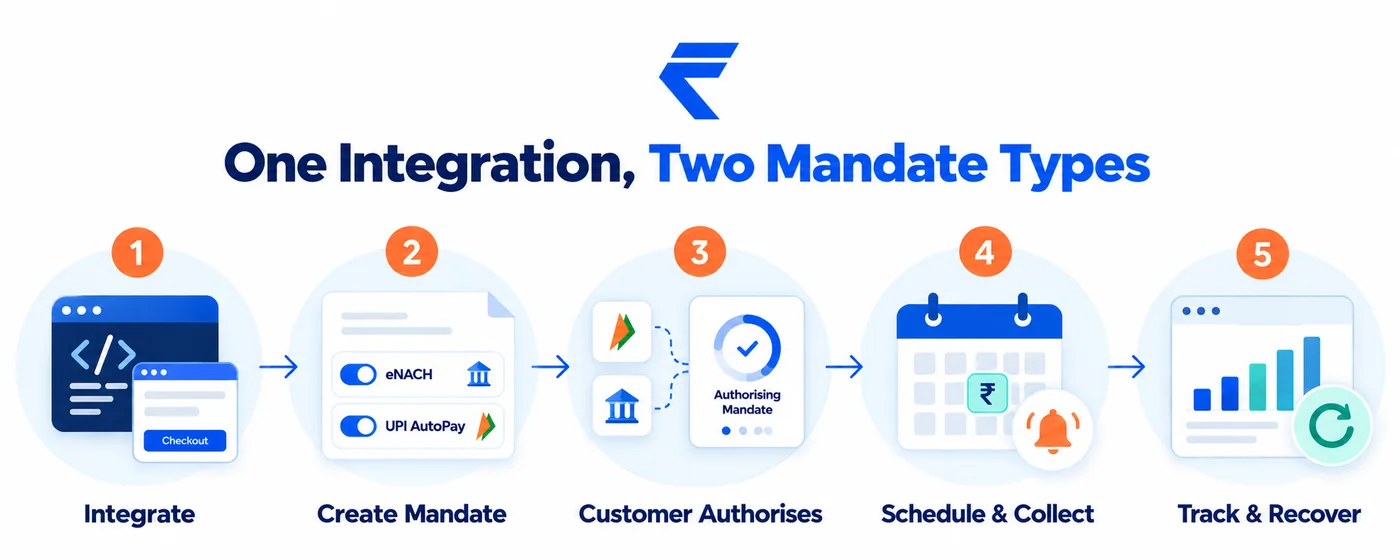
RocketPay runs UPI AutoPay and eNACH mandates on one platform, so each customer can sit on the rail that fits their debit size. It can also work on top of your existing payment provider’s credentials.
Integrate once. Integrate through RocketPay’s single API, or use the Android app. Go live in 48 hours.
Create the mandate. Use UPI AutoPay for debits up to ₹15,000 and eNACH above that, and set the amount, frequency and start date.
Customer authorises. For UPI AutoPay, the customer approves through a mandate link or QR code with their UPI PIN; for eNACH, they authenticate with net banking, a debit card or Aadhaar OTP.
Schedule and collect. Debits run on the due date, a pre-debit notification goes out before each one, and funds settle to your account on T+1.
Track and retry. See every mandate’s status in real time and, when a debit fails, schedule a retry for a date you agree with the customer.
Talk to the RocketPay team to see which setup suits your ticket sizes and customer mix.
Verdict: Matching the Rail to Your Collections
Choose by ticket size and customer behaviour:
Up to ₹15,000 per debit, including loan EMIs: UPI AutoPay.
Above ₹15,000 per debit, or B2B collections: eNACH.
A mix of both: Use both, and route by instalment size.
If you can only pick one and most debits are ₹15,000 or less, start with UPI AutoPay for faster sign-up. If most instalments are larger, such as EMIs above ₹15,000, eNACH is the safer choice. If your instalments fall on both sides of ₹15,000, offer both.
Key Takeaways
Debit size decides most cases. UPI AutoPay runs without extra authentication up to ₹15,000 per debit, or ₹1 lakh for insurance premiums, mutual fund SIPs and credit card bills. Larger debits, including loan EMIs above ₹15,000, belong on eNACH.
The ₹15,000 limit applies to each debit, not to the loan or contract. A large total can still run on UPI AutoPay if every instalment stays within it.
UPI AutoPay is live as soon as the customer enters their UPI PIN. An eNACH mandate takes up to three days to register, so schedule the first debit at least three days after creation.
A bounced eNACH debit usually costs the customer a charge from their own bank. A failed UPI AutoPay debit usually does not.
Customers can revoke UPI AutoPay mandates from their UPI app, except non-cancellable loan-repayment mandates that regulated lenders can use. eNACH cancellation runs through the customer’s bank.
Match every instalment to the right rail
RocketPay runs UPI AutoPay and eNACH mandates on one platform with T+1 settlement, and you can go live in 48 hours.
Book a Demo →
Frequently asked questions
Which is better for high-value recurring payments, eNACH or UPI AutoPay?
eNACH is usually the better fit for high-value collections such as large loan EMIs, big insurance premiums and B2B payments. It supports much higher mandate ceilings. UPI AutoPay runs without extra authentication only up to ₹15,000 per debit, or ₹1 lakh for SIPs, insurance premiums and credit card bills. Above that, the customer has to approve each debit with their UPI PIN, which defeats the point of auto-debit.
Can a business offer both eNACH and UPI AutoPay to customers?
Yes. Many businesses offer both and route by ticket size or customer preference. For example, a business can lead with UPI AutoPay for smaller plans and offer eNACH for larger ones. Having both also gives customers who cannot use UPI another way to set up a mandate.
Why do UPI AutoPay mandates sometimes fail on the debit date?
The most common reasons are insufficient balance in the customer's account, UPI or bank downtime, a debit amount above the maximum set in the mandate, a mandate the customer has paused or revoked, and a debit above ₹15,000 (or ₹1 lakh for SIPs, insurance premiums and credit card bills) that needs the customer's UPI PIN. Spacing out retries and sending pre-debit reminders can reduce failures.
How long does eNACH registration take compared to UPI AutoPay?
UPI AutoPay is real time. The customer approves with a UPI PIN and the mandate is active straight away. eNACH takes longer. Registration can take up to three days, so schedule the first debit at least three days after the mandate is created.
What is the maximum transaction limit for UPI AutoPay in 2026?
The standard limit is ₹15,000 per debit without extra authentication. For mutual fund SIPs, insurance premiums and credit card bill payments, it goes up to ₹1 lakh. Both limits come from RBI's Digital Payments E-mandate Framework, 2026. Above them, each debit needs the customer's UPI PIN.
Do UPI AutoPay and eNACH support one-time future-dated payments?
Both can generally handle a single debit scheduled for a future date, in addition to recurring cycles, though support depends on your provider and the mandate configuration. With either method, set the mandate frequency and start date at creation. Confirm one-time mandate support with your provider.
Which method is quicker for customers to approve?
UPI AutoPay usually takes fewer steps. The customer enters their UPI PIN in an app they already use, while eNACH asks them to authenticate with their bank through net banking, a debit card or Aadhaar OTP. Once a mandate is active, insufficient balance causes failures on both rails, and debit success depends on the provider, retry timing and customer base.
Can I migrate a customer from eNACH to UPI AutoPay mid-cycle?
Not as a direct conversion. A mandate cannot be converted from one type to the other. The customer has to create a new UPI AutoPay mandate, and you then cancel the old eNACH one. To avoid a double debit, time the switch between billing dates, and confirm the old mandate is cancelled before the next cycle. Tell the customer clearly which mandate will be used for the next charge.
