Complete Guide to Microfinance Collections and Digital Repayment (2026)
A practical guide for MFIs in India to improve collection efficiency, cut PAR and move routine EMIs to UPI AutoPay and eNACH, without adding pressure on borrowers or field teams.
·
13 min read
·
RocketPay Editorial
TL;DR
Microfinance loans are repaid weekly or fortnightly, without collateral, so a small rise in missed instalments quickly shows up in portfolio at risk. This guide covers RBI's recovery rules for microfinance loans, including the calling-hours change from 1 January 2027, the KPIs to track, and how UPI AutoPay and eNACH mandates collect routine instalments on the due date. Field teams can then spend their time on the borrowers who need a conversation.
Microfinance institutions lend small amounts without collateral, to borrowers whose income rarely follows a neat monthly calendar. That makes repayment discipline the most important asset on the books, and collections the most important operating function. The sector has recovered well from its recent stress. According to MFIN's Micrometer, portfolio at risk in the 31 to 180 day bucket across the microfinance industry fell to 1.6% as of June 30, 2026, from 5.6% a year earlier. But the last two years showed how quickly weak collections turn into write-offs.
What Are Microfinance Institutions (MFIs) and How Do They Operate in India?
Microfinance institutions (MFIs) are financial entities that provide small loans, usually without collateral, to low-income households and micro entrepreneurs who lack access to traditional bank credit. In India, most of their borrowers are women in rural and semi-urban areas.
Here is how the model works:
Who lends: NBFC-MFIs, small finance banks, banks and Section 8 companies all offer microfinance loans, with NBFC-MFIs forming the largest group of dedicated lenders.
How they lend: Most MFIs lend through joint liability groups (JLGs), where group members support each other's repayment. Ticket sizes have been rising: the average microfinance disbursement reached about ₹61,500 by March 2026, up from about ₹48,300 two years earlier, according to CareEdge Ratings.
How they collect: Repayments are often due weekly or fortnightly, and are collected at group meetings or by field officers visiting borrowers.
Where they operate: As of June 30, 2026, the East and North-East region holds the largest share of the industry portfolio at 36.6%, and Bihar, Uttar Pradesh and Tamil Nadu are the top three states by portfolio share (MFIN).
To see how RocketPay supports loan collections for microfinance institutions, visit our MFI page.
The Collections Challenge Unique to Microfinance Institutions
Collections at a microfinance institution are unlike collections at a bank or a large NBFC. Four features make them harder:
No collateral: There is no asset to fall back on, so repayment depends on borrower discipline and group trust.
Very high frequency: A loan repaid weekly over a year involves about 52 collection events per borrower. Across lakhs of borrowers, even a small failure rate becomes a large number of missed EMIs every week.
Small tickets: A visit that costs the same whether the EMI is ₹500 or ₹5,000 eats into margin fast.
Group dynamics: One default can weaken repayment behaviour across an entire group.
The cost of getting this wrong is visible in the numbers. CareEdge Ratings estimates that write-offs and sales to asset reconstruction companies in FY2025 and FY2026 together exceeded 17% of the March 2024 loan book of the NBFC-MFIs it rates. Collecting on time is far cheaper than recovering late, which is why prevention has become the priority.
Traditional Cash-Based Collection Models: Why They're Breaking Down
For decades, MFI collections meant a field officer, a group meeting and a bag of cash. That model built the sector, but it struggles at today's scale. The main cracks are:
High travel and time cost: Officers spend a large part of the day travelling between meetings, often to collect from borrowers who would have paid anyway.
Cash leakage and delayed deposits: Money handled by hand can be lost, misreported or deposited late, and every delay distorts the day's collection numbers.
Weak audit trail: Cash receipts are slow to reconcile, so management sees the true picture of PAR days after it has already moved.
Safety risk: Carrying cash through remote areas exposes officers and the institution to real danger.
Officer attrition: In a cash model, the borrower relationship lives with the officer. When the officer leaves, collection quality often falls with them.
Changing borrower behaviour: Many rural borrowers now have bank accounts and use UPI, but cash-only models ignore this.
Cashless collections remove most of the cash-handling risks. Money moves from the borrower's account to the lender's on the due date, so there is no cash to carry, lose or deposit late, and every repayment leaves a record.
The real problem is not the visit itself. It is making about 52 visits per loan when many of them never needed to happen.
RBI Regulatory Guidelines Governing MFI Collections
Every microfinance institution in India operates inside a regulatory framework that shapes how collections can be done. The key provisions are:
Regulatory framework for microfinance loans (first issued in 2022): RBI brought banks, co-operative banks and NBFCs lending to low-income households under one framework (see RBI's Master Direction on microfinance loans). It defines a microfinance loan as a collateral-free loan to a household with annual income up to ₹3 lakh, and caps a household's monthly loan repayments, across all its loans, at 50% of its monthly household income.
Fair Practices Code: Every lender must adopt a board-approved Fair Practices Code, display it in its offices and on its website in a language the borrower understands, and apply it whether collections are handled by an in-house team or an outsourced agent.
Recovery conduct: For overdue microfinance loans, RBI treats calling a borrower before 9:00 AM or after 6:00 PM as a harsh recovery practice, along with persistent calling, threatening or abusive language, harassing the borrower's relatives, friends or co-workers, and publishing borrowers' names. The timing limit applies to recovery of overdue loans, not to routine group meetings or regular collections. Recovery should take place at a designated or central place agreed with the borrower, and field staff can visit a home or workplace only if the borrower fails to appear there on two or more successive occasions.
Change from 1 January 2027: Under amendment directions issued on 6 August 2026, RBI sets one contact window for regulated lenders: borrowers can be contacted or visited only between 8:00 AM and 7:00 PM, unless the borrower requests otherwise. For NBFC-MFIs this replaces the separate 9:00 AM to 6:00 PM limit. The designated-place rule for microfinance recovery continues.
Grievance redressal: Lenders must have a mechanism for recovery-related grievances, share its details with the borrower at disbursal, and print the nodal officer's name and contact number on the loan card.
Industry self-regulation: MFIN's Code of Conduct and lending guardrails, including a limit on the number of lenders per borrower, add a further layer of discipline for member institutions.
For call structure, scripts and objection handling, see our guide to debt collection calls.
Common Reasons for Missed Repayments in Microfinance
Many missed EMIs in microfinance are not wilful defaults. They usually trace back to a handful of causes:
Irregular or seasonal income: Farm work, daily wages and small trade produce uneven cash flow, and a due date does not always match a payday.
Multiple lenders: Borrowers juggling several loans can find their total repayments outgrowing their household income.
Emergencies: A medical expense or a family event can wipe out a week's repayment money.
Weather and local shocks: Floods, droughts and local disruption hit an entire area at once.
Missed meetings or unclear schedules: A borrower who does not know exactly what is due, or when, often pays late by accident.
Insufficient balance on the due date: The money exists, but it has not reached the account yet. This is a common cause of an EMI bounce, where the debit fails and the instalment is marked overdue.
The last cause is the one digital collections address most directly. When a mandate failure or NACH bounce happens, a good system can retry and recover whatever balance is available instead of letting the EMI bounce into delinquency.
The Shift to Digital Repayment: UPI AutoPay, eNACH and QR Codes for MFIs
Digital loan collections let the repayment happen without the field visit, through automated repayments on the due date. Three tools matter most for microfinance institutions.
UPI AutoPay
The borrower authorises the mandate once, and the EMI is debited automatically on each due date. UPI AutoPay supports recurring frequencies that include weekly and fortnightly, which fits the standard MFI repayment cycle. It works best for borrowers who already use UPI on a smartphone.
eNACH
With eNACH, the borrower authorises recurring debits from their bank account, usually through net banking, debit card or Aadhaar OTP. It suits instalments above ₹15,000 and borrowers who are comfortable with their bank account but less so with UPI apps. Registration can take up to three days, so plan the first debit date with that buffer.
QR codes
A QR code at the group meeting gives borrowers a digital way to pay in the moment. It is a useful fallback for borrowers who do not yet have an active mandate.
What a strong digital setup includes
Basic mandate registration is not enough for high-frequency collections. A good setup adds:
Retries: A failed debit can be attempted again, including more than once in a day or on a date agreed with the borrower, instead of waiting for a field visit.
Partial recovery: Using Account Aggregator (AA) data, the system recovers whatever balance is available even when the full EMI is not.
Non-cancellable mandates: UPI AutoPay mandates for regulated lenders can be set up so the borrower cannot revoke them from their UPI app mid-loan.
Real-time status: Every debit, failure and retry is visible to the operations team as it happens.
See how weekly EMI collection on mandates works for lenders.
Running weekly collections across hundreds of centres?
See how UPI AutoPay and eNACH mandates collect each instalment on the due date, before a field visit is needed.
Portfolio at Risk (PAR) and Other KPIs MFIs Must Track
Portfolio at Risk (PAR) is the share of the outstanding loan portfolio that has one or more instalments overdue beyond a set number of days. It is the first number lenders, rating agencies and investors check when judging portfolio quality.
Track these KPIs together:
PAR1, PAR30 and PAR90: PAR1 shows the earliest signs of slippage, PAR30 shows whether early delinquency is being contained, and PAR90 shows loans that have already crossed into NPA territory, since RBI classifies a loan as non-performing once it is more than 90 days overdue.
Collection efficiency: The amount collected as a share of the amount due in a period. It shows how well the field or digital operation is performing right now.
First EMI default rate: A high rate here often points to a problem in loan appraisal or borrower onboarding rather than collections.
Cost per rupee collected: This tells you whether your collection model is sustainable at small ticket sizes.
Write-off ratio and GNPA: These show how much stress has already turned into loss.
The industry data shows why this matters. PAR 31 to 180 improved sharply over the past year. Tracking delinquency by bucket, not just overall collection efficiency, lets a lender see early slippage before it ages. For more, see how delinquency buckets work in our debt management services guide.
Field Officer Best Practices for Sensitive Rural Collections
Even with digital repayment, field officers remain essential, especially for exceptions and early-stage delinquency. How they conduct themselves decides whether a borrower relationship survives a missed EMI. The most effective practices are:
Remind before the visit: Send an SMS, WhatsApp or IVR reminder before the due date, so the visit is never the borrower's first notice. Our guide to automated payment reminders covers reminder timing and channels.
Respect timing, place and language: For overdue accounts, contact borrowers only within RBI's permitted hours, 9:00 AM to 6:00 PM for microfinance loans until 31 December 2026 and 8:00 AM to 7:00 PM from 1 January 2027. Meet at the agreed centre before visiting a home or workplace, speak in the borrower's language and keep the tone calm.
Ask before you demand: Understand why the payment was missed before presenting the amount overdue.
Restructure instead of escalating: If a borrower faces a genuine hardship, route them to a rescheduling or restructuring discussion rather than repeated pressure.
Keep group meetings free of public shaming: Group meetings must never become a venue for calling out individual borrowers.
Follow a documented escalation ladder: Every step from reminder to senior review should be recorded and consistent with the Fair Practices Code.
Spend field time on exceptions: When routine EMIs are collected by mandate, officers can focus on the accounts that actually need a conversation.
Using Technology to Improve Collection Efficiency at Scale
Technology does not replace the relationship at the heart of microfinance. It removes the repetitive work around it so that relationships get more attention where they matter. The tools worth building around are:
LMS and LOS integration: Mandates, collections and repayment schedules should sit inside your loan management system, so reconciliation happens automatically.
Real-time dashboards: Live visibility into days past due and bucket movement lets managers act in days instead of weeks.
Automated reminders: SMS, WhatsApp and IVR messages before and after the due date cut accidental delays.
Retry logic and partial recovery: Automated retries and AA-based recovery bring in payments that would otherwise slip into delinquency.
Early warning signals: Patterns such as repeated failed debits or a late first EMI help managers prioritise field visits before an account becomes a PAR problem.
At scale, the difference is significant. A team of ten officers can manage a far larger portfolio when the system handles routine collections and flags only the accounts that need attention.
The Case for a Hybrid Cash + Digital Collection Model
Going fully digital overnight is neither realistic nor necessary. Some borrowers do not have active bank accounts or smartphones, and group meetings remain valuable. The strongest approach is digital by default, with field collection for exceptions.
In practice, that means:
Mandates for routine EMIs, so most repayments happen on the due date without any visit.
Cash for borrowers without an active bank account, and QR codes for banked borrowers who have not yet set up a mandate, so no one is excluded.
Field visits for early-stage delinquency, where a conversation can prevent a small miss from becoming a large one.
A phased rollout: Start with new loan cycles or a single branch, measure the change in collection efficiency and PAR, and then scale.
With this model, the team manages exceptions instead of chasing every borrower every cycle.
How RocketPay Can Support MFI Collections at Scale
RocketPay is collections infrastructure built for Indian lenders, including microfinance institutions running weekly and fortnightly cycles and group lending models.
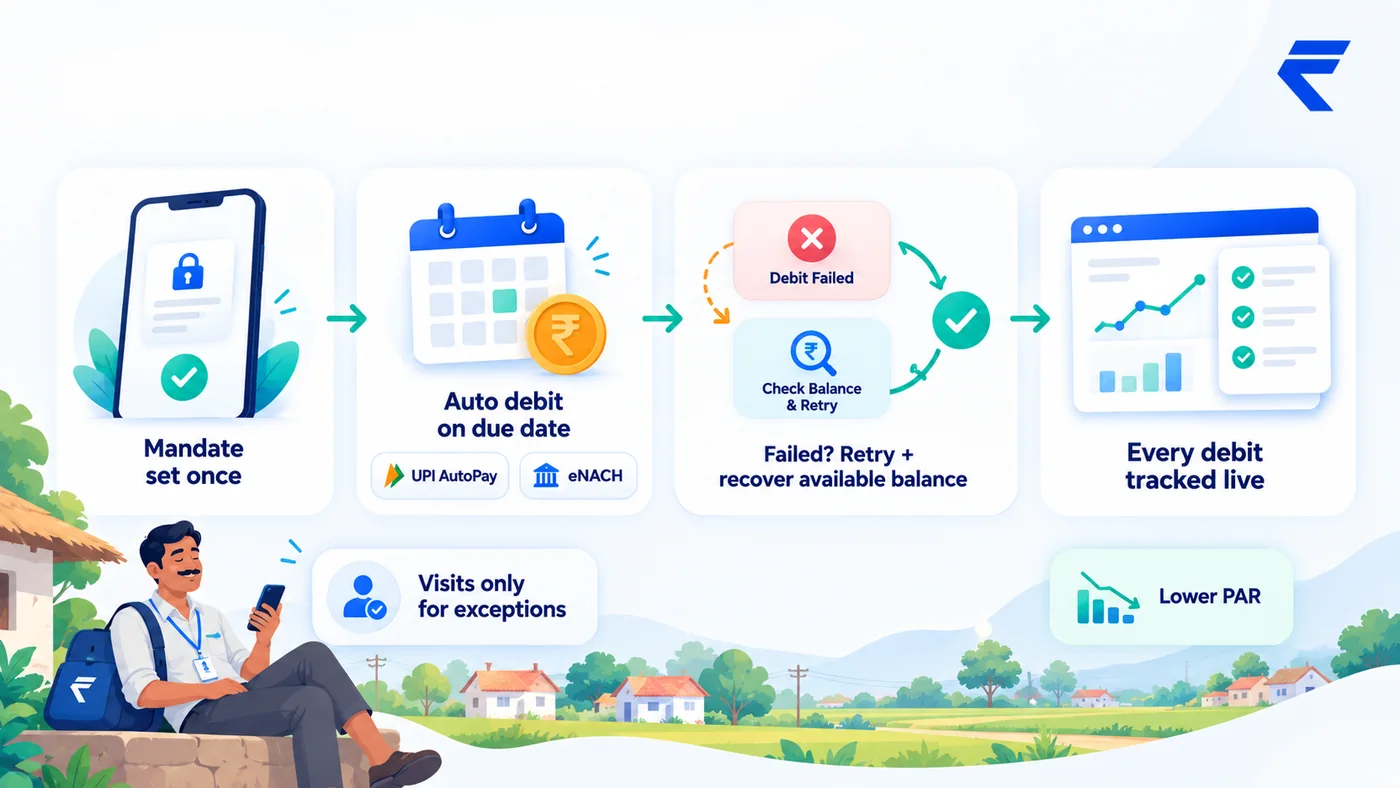
Once a borrower registers a mandate, RocketPay runs the collection from start to finish. On the due date it raises a debit through UPI AutoPay or eNACH. If the debit fails, it checks the available balance using Account Aggregator data and recovers what is present, while intelligent retry attempts the debit again. Non-revocable mandates help protect the collection cycle, and every attempt, status change and settlement is logged in real time, visible on a dashboard or through an API webhook.
For MFIs, that comes with:
API integration with your LMS or LOS, or an Android app for smaller lenders and hybrid field teams.
Go live in 48 hours with a dedicated account manager.
T+1 settlement, with a stack built on NPCI infrastructure and integrated with 30+ banks.
Conclusion
A strong collections process is not about pushing borrowers harder. It is about combining regulatory discipline, digital repayment and respectful field practice into one system, and measuring it with the right KPIs.
For an MFI, collection efficiency is decided at the centre meeting and on the due date. Put routine instalments on mandates, keep field time for the borrowers who need a conversation, and track PAR by bucket so slippage shows up early.
Key Takeaways
Cash-only collections are costly, slow to reconcile and hard to audit at MFI scale.
Until 31 December 2026, RBI treats calls to overdue microfinance borrowers before 9:00 AM or after 6:00 PM as harsh. From 1 January 2027 a uniform 8:00 AM to 7:00 PM window applies, and recovery still starts at an agreed central place.
UPI AutoPay suits instalments up to ₹15,000 per debit and eNACH covers larger ones. Retries and partial recovery help recover failed debits before they age.
Track PAR by bucket alongside collection efficiency and cost per rupee collected. PAR90 is already NPA territory.
A hybrid model works best: mandates by default, cash or QR for exceptions, and field visits for early delinquency.
Prevent the missed EMI, skip the recovery.
RocketPay runs mandate-based collections for NBFCs, MFIs and other regulated lenders across India, on UPI AutoPay and eNACH.
Book a Demo →
Frequently asked questions
What is a microfinance institution?
A microfinance institution (MFI) is a financial entity that provides small, usually collateral-free loans to low-income households and micro entrepreneurs who lack access to formal banking. In India, MFIs include NBFC-MFIs, small finance banks and other regulated lenders, and most of their borrowers are women in rural and semi-urban areas.
Why is collection efficiency so critical for microfinance institutions in India?
MFI loans are unsecured, so timely repayment is the only source of return. Collections happen weekly or fortnightly across a large number of small loans, so even a small drop in efficiency quickly raises PAR, increases provisioning and limits the capital available for new lending.
How does the joint liability group model help MFIs recover loans?
In a joint liability group, members are collectively responsible for repayment. Peer support and social accountability encourage borrowers to repay on time, and group members often help a struggling member before the account becomes delinquent. It works best alongside respectful, compliant field practice, not pressure.
Can MFIs use UPI AutoPay for weekly or fortnightly loan repayments?
Yes. UPI AutoPay supports recurring mandates at frequencies that include weekly and fortnightly, so it fits standard MFI repayment cycles. The borrower authorises the mandate once, and the EMI is debited automatically on each due date. UPI AutoPay debits run without extra authentication up to ₹15,000 each; above that the borrower must approve each debit with their UPI PIN, so larger instalments are better on eNACH. A collections platform can also add retry and partial recovery for failed debits.
What is PAR30 and why do MFI investors care about it?
PAR30 is the share of the outstanding portfolio with at least one instalment overdue by more than 30 days. Investors and rating agencies watch it because it signals early stress, before loans move toward NPA status. A rising PAR30 usually means write-offs and higher provisioning are coming.
Are MFI recovery agents bound by RBI's Fair Practices Code?
Yes. Whether collections are handled by an in-house team or an outsourced agent, they must follow the lender's Fair Practices Code, which RBI requires every lender to adopt. Until 31 December 2026, RBI treats calling a borrower with an overdue microfinance loan before 9:00 AM or after 6:00 PM as a harsh practice. From 1 January 2027, a uniform 8:00 AM to 7:00 PM contact window applies. Agents must carry an identity card and an authorisation letter, and threatening language, harassing the borrower's relatives or co-workers, and publishing borrowers' names are all prohibited.
How can MFIs reduce their dependence on physical cash collections?
The most effective way is to shift routine EMIs to digital mandates while keeping field teams for exceptions. Register borrowers on UPI AutoPay or eNACH mandates, use QR codes at group meetings as a fallback, and add retry and partial recovery for failed debits. Start with new loan cycles, then scale across branches.
What are the biggest reasons small borrowers default in rural India?
The most common causes are irregular or seasonal income, borrowing from multiple lenders, medical or family emergencies, weather and local shocks, and unclear repayment schedules. Many missed EMIs also happen simply because the account balance is short on the due date, which is why retry and partial recovery help.
